Company Cars Made Available for Private Use: what Changes from 2026
Company Cars Made Available for Private Use: what Changes from 2026
Prepared by Marzio Scaglioni and Silvia Capobianco
With the enactment of Legislative Decree No. 148/2026 (the so-called Omnibus Corrective Decree), the tax framework governing company cars made available for both business and private use to employees and collaborators has been substantially revised.
The changes extend beyond the calculation of the fringe benefit itself and will have a direct impact on fleet management, vehicle assignment policies and payroll processes.
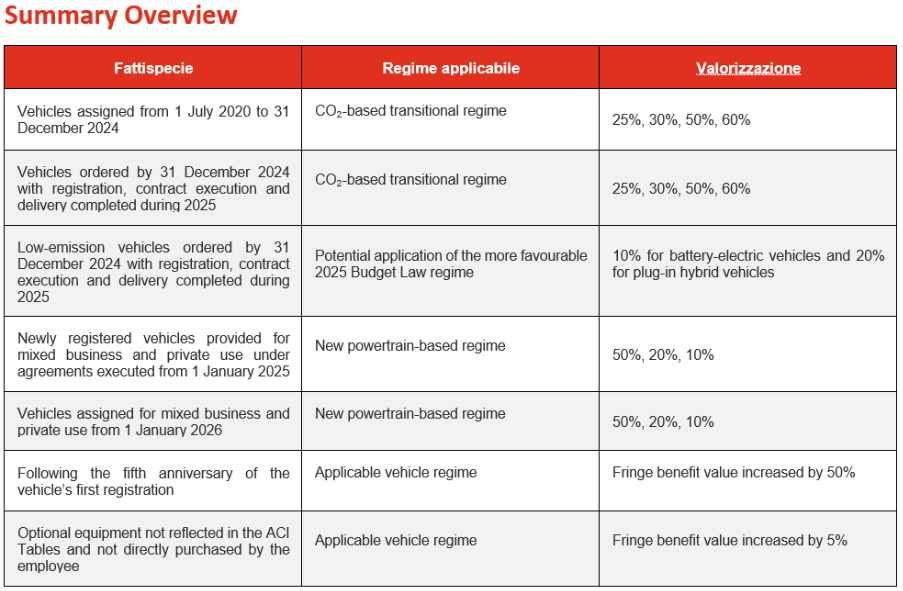
The reform confirms the shift from the previous methodology based on CO₂ emissions to a system driven by the vehicle’s powertrain. Accordingly, the fringe benefit continues to be determined by applying a 50% percentage for conventional vehicles, reduced to 20% for plug-in hybrid vehicles and 10% for battery-electric vehicles. The taxable value remains based on the ACI tables and on a conventional annual mileage of 15,000 kilometres.
Among the most significant changes introduced by the Decree is the removal of certain requirements that had characterized the framework introduced by the 2025 Budget Law. For the purposes of the flat-rate determination of the fringe benefit, the legislation no longer requires the vehicle to be newly registered and no longer refers to the requirement that the vehicle assignment agreement be entered into on or after 1 January 2025. The provision now refers solely to the vehicle being made available for both business and private use.
Another significant development concerns the age of the vehicle. From 1 January of the year following the fifth anniversary of the vehicle’s first registration, the value of the fringe benefit will be increased by 50%, regardless of the vehicle’s powertrain.
The legislator has also introduced specific provisions relating to optional equipment and vehicle fittings. From 2026, where a vehicle includes accessories or optional equipment that are not reflected in the ACI tables and whose cost is not borne directly by the employee, the value of the fringe benefit will be increased by a flat-rate 5%.
Particular attention should also be paid to the revised transitional regime. The Omnibus Corrective Decree extends the grandfathering provision to vehicles ordered by 31 December 2024 and for which registration, assignment and delivery occur during the entire 2025 calendar year. As a result, the rules in force as at 31 December 2024, based on CO₂ emissions, will continue to apply not only to vehicles assigned by 30 June 2025, but also to those assigned during the second half of 2025, thereby avoiding the application of the open market value method.
In this respect, an additional point of interest concerns low-emission vehicles ordered by 31 December 2024 for which registration, execution of the relevant agreement and delivery to the employee are all completed during 2025. Consistent with the principles set out by the Italian Revenue Agency in Circular No. 10/E of 2025, aimed at supporting the energy transition without unduly penalizing businesses and employees, the more favourable regime introduced by the 2025 Budget Law may continue to apply to these vehicles.
Consequently, battery-electric vehicles and plug-in hybrid vehicles could continue to benefit from fringe benefit percentages of 10% and 20%, respectively, considering that all the requirements set out by the new rules are nevertheless fulfilled during 2025.
The Decree also addresses the reassignment of company vehicles, expressly clarifying that the applicable tax regime remains linked to the vehicle itself rather than to the employee to whom it is assigned. Accordingly, the replacement of the employee using the vehicle does not result in any change to the applicable fringe benefit determination rules.
From an operational perspective, companies will be required to undertake a detailed review of the information available regarding their vehicle fleets. The date of first registration, vehicle delivery date, assignment history, presence of optional equipment and correct identification of the applicable tax regime will become key factors in ensuring the accurate calculation of fringe benefits and the proper management of tax and social security obligations.
With specific reference to optional equipment, the legislator further clarifies that any approaches adopted by employers up to 31 December 2025 in relation to the taxation of accessories and vehicle fittings remain valid. In addition, no refund will be available for any additional taxes that may already have been paid.
For the 2026 tax year, employers should therefore assess the impact of the new rules on fringe benefits already processed during the year and, where necessary, perform the relevant tax and social security year-end adjustments.
Ultimately, Legislative Decree No. 148/2026 confirms the ongoing transition towards a more sustainable model of corporate mobility. At the same time, it introduces new operational complexities that will require greater coordination among fleet management, HR, tax and payroll functions, together with a review of internal procedures governing company vehicles made available for both business and private use.